
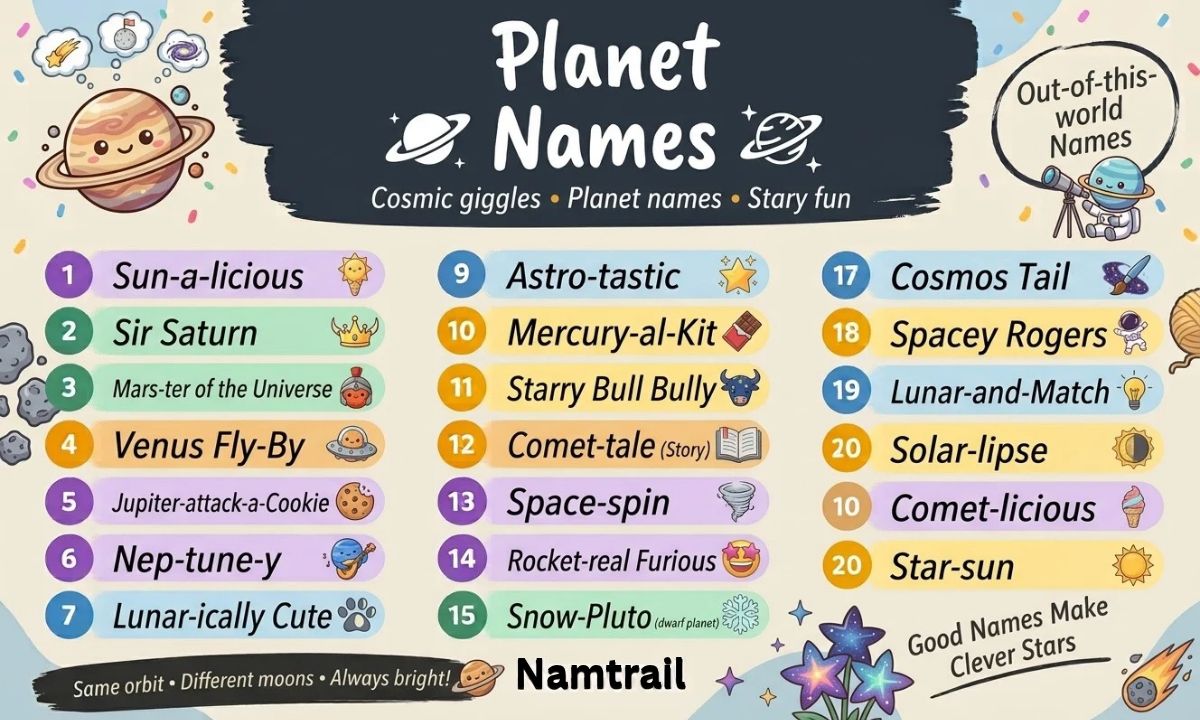
Creating a planet name is one of the most exciting parts of building a fantasy or sci-fi world. A good name can make your planet feel real and alive. It can hint at the climate, the culture, or the history of that world. Readers often remember a story because of its unique planet names.
Choosing the right name takes more than just picking random words. You want something that sounds believable yet original. Many writers mix real astronomy terms with invented sounds. Others draw ideas from mythology, nature, or foreign languages. This mix helps create names that feel both fresh and familiar.
Whether you are writing a novel, building a game, or designing a tabletop campaign, this list will help. We have gathered creative planet name ideas across different styles and themes. You will find options for dark worlds, peaceful worlds, and everything in between. Pick a name that matches the story you want to tell.
Pro Tip: Say your chosen name out loud before using it. A name that flows smoothly is easier for readers to remember and enjoy.
Best Planet Names Generator
How Real Planets Get Their Names
Real planets do not get random names. Space experts follow strict rules to name them. The International Astronomical Union, or IAU, controls this process. They have named planets and moons for many years.
Most planets in our solar system carry names from Roman gods. Mercury, Venus, Mars, and Jupiter all come from old myths. Each god’s traits often match the planet’s nature. Mars looks red, so it was named after the god of war.
Moons and small bodies follow different naming themes. Some moons carry Greek names, while others use characters from myths and literature. Scientists pick names that fit a clear pattern for each group. This keeps space naming organized and easy to understand.
New planets found outside our solar system get different names. These are called exoplanets. They often carry codes with letters and numbers instead of story-based names. Sometimes the public can vote on fun nicknames for these distant worlds.
How Our Solar System’s Planets Got Their Names
Long before telescopes existed, ancient peoples looked up and named the wandering lights in the sky after their most powerful gods. The Romans get most of the credit for the names we use today, since Western astronomy inherited its naming conventions from Latin.
- Mercury – Named for the swift Roman messenger god, because it zips around the Sun faster than any other planet.
- Venus – Named for the Roman goddess of love and beauty, since it’s the brightest and most dazzling object in the night sky besides the Moon.
- Earth – The odd one out; it comes from Old English/Germanic words simply meaning “the ground” or “the soil,” not mythology.
- Mars – Named for the Roman god of war, likely because of its blood-red color.
- Jupiter – Named for the king of the Roman gods, fitting for the largest planet in the solar system.
- Saturn – Named for the Roman god of agriculture and time, Jupiter’s father in myth.
- Uranus – Named for the ancient Greek god of the sky, the only planet with a Greek (not Roman) name.
- Neptune – Named for the Roman god of the sea, thanks to its deep blue color.
- Pluto – Named for the Roman god of the underworld, fitting for a cold, distant world at the edge of the solar system.
Pro Tip: When inventing your own planet names, borrow this same logic — pick a real or invented deity/force that matches the planet’s personality (color, size, danger level), and the name will feel instantly “official.”
Best Planet Names With Meanings & Origin Table
This table blends real astronomical names, mythological roots, and invented-but-plausible names so you can see exactly how meaning and sound work together.
| Name | Meaning/Origin |
| Terra | Latin for “Earth” |
| Solara | From “solar,” suggesting a sun-bright world |
| Vesperia | From “vesper,” Latin for evening |
| Astraeus | Greek titan god of the stars |
| Cindara | Invented, evokes “cinder” |
| Nocturne | Latin/French for “of the night” |
| Aurelia | Latin, “golden” |
| Zephyros | Greek god of the west wind |
| Umbriel | From “umbra,” Latin for shadow |
| Caelum | Latin for “sky” or “heaven” |
| Thessaly | Greek region name, mythic feel |
| Vireth | Invented, sounds ancient |
| Ondera | Invented, echoes “wonder” |
| Solmara | Invented, sun + sea |
| Duskara | Invented, evokes dusk |
| Ferrous | Latin root for “iron,” a rusty world |
| Glaciem | From Latin “glacies,” ice |
| Pyralis | Greek root “pyr,” fire |
| Verdania | From “verdant,” a green world |
| Marisol | Spanish, “sea and sun” |
| Kryosa | From Greek “kryos,” cold |
| Novaris | From “nova,” a new/bright star |
| Aetheris | From Greek “aether,” upper sky |
| Boreas | Greek god of the north wind |
| Selenar | Root of “Selene,” Greek moon goddess |
Pro Tip: Naming a planet works best when the meaning matches its visual identity — icy worlds should sound cold and sharp (Kryosa), fiery worlds should sound hot and heavy (Pyralis).
More Best Planet Names
- Astravia
- Elyndor
- Thessaria
- Voxaris
- Meridian
- Calderyn
- Solthera
- Nythera
- Auristar
- Braxos
- Corvantis
- Delphara
- Emberlyn
- Faelora
- Gravenor
- Halcyra
- Ithralon
- Junipex
- Kaldris
- Lumenar
- Marethis
- Nevastra
- Orindal
- Prysma
- Quenara
- Ravanor
- Solmerith
- Thalvora
- Umbraxis
- Vesparis
- Wrenholt
- Xantheris
- Ysolde
- Zenithar
- Corenthia
Pro Tip: Invented names sound more real when you build them from two familiar word-roots (like “Lumen” + “ar”) — the brain recognizes the pieces even if the word is brand new.
Fictional & Made-Up Planet Names
- Xantoris
- Velmara
- Drogath
- Nyxandria
- Corvellon
- Aethelor
- Bryxis
- Zephyrion
- Kelvora
- Threnody
- Malvorn
- Serenthis
- Grimwald
- Ossandra
- Tenebros
- Vulcanis
- Orovane
- Pallanor
- Rystoria
- Skavaris
- Thornwake
- Ulvarran
- Vexholt
- Wraithara
- Yveldros
Pro Tip: When a made-up name needs to feel massive and dangerous, favor hard consonants (K, X, V, T); for gentler, dreamlike worlds, lean on soft sounds (L, S, N, M).
Alien Planet Names
- Xerath-9
- Vorlaxis
- Kryxil Prime
- Thal’zor
- Nebuxion
- Qorvath
- Zylanthe
- Drivaxx
- Morvethis
- Skarnos
- Yulvarin
- Praxidon
- Ixthara
- Golvexx
- Wentharis
- Ozrikon
- Belquora
- Fendral IV
- Grixnar
- Hyzalon
- Jothrenix
- Klaxoria
- Nulveth
- Ravothar
- Voxtandra
Pro Tip: Apostrophes, unusual letter pairs (X, Q, Z), and numerals (“Prime,” “IV”) instantly signal “alien” to readers — but use them sparingly so names stay pronounceable.
Fantasy Planet Names
- Aeloria
- Duskmere
- Faewend
- Glimmerholt
- Ivoryn
- Larkspire
- Moonveil
- Nightgarde
- Opalis
- Starhollow
- Thistlemoor
- Underlight
- Valewick
- Willowmere
- Wyrmscale
- Amberfell
- Briarwyn
- Cindermoor
- Dawnspire
- Emberglen
Pro Tip: Fantasy planet names borrow heavily from nature words (moon, star, thorn, glen) fused with medieval-sounding endings like “-wyn,” “-mere,” or “-holt.”
Cool Planet Names
- Vantablack
- Ionis
- Crysalar
- Nexovar
- Solstice IX
- Draxion
- Frostbyte
- Velaris
- Zenoxx
- Obsidara
- Pulsaris
- Neonyx
- Cobaltis
- Tectonaris
- Gravitum
- Voltrex
- Chromis
- Static-7
- Voidmark
- Titanova
Pro Tip: “Cool” names often mix a scientific-sounding word (ion, volt, pulsar) with an invented suffix — it makes the name feel futuristic without being a real word.
Unique & Creative Planet Names
- Quillendra
- Bythos
- Naethera
- Orravel
- Sundrift
- Thalorra
- Veynith
- Wysteria Prime
- Xandrivel
- Yolanthe
- Zirconyx
- Ambervale
- Brindlewick
- Corsivane
- Delvorra
Pro Tip: To keep an invented name feeling unique rather than random, decide on a “flavor rule” first (all vowel-heavy, all ending in -a, all nature-based) and apply it consistently across your naming list.
Mythology-Inspired Planet Names
Mythology is the deepest well any namer can draw from — thousands of years of gods, monsters, and cosmic forces already carry built-in meaning and gravitas.
- Prometheus
- Icarus
- Pandora
- Chronos
- Helios
- Nyx
- Gaia
- Atlas
- Persephone
- Hades
- Fenrir
- Loki
- Odin
- Anubis
- Osiris
- Kali
- Shiva
- Quetzalcoatl
- Tlaloc
- Ra
Pro Tip: Using a real mythological name instantly borrows that god’s “personality” for your planet — Hades feels dark and forbidding without any extra explanation needed.
Greek & Roman Mythology Planet Names
- Apollo
- Artemis
- Athena
- Demeter
- Hermes
- Hera
- Poseidon
- Dionysus
- Hephaestus
- Hestia
- Eros
- Nike
- Selene
- Eos
- Thanatos
- Hypnos
- Morpheus
- Tyche
- Nemesis
- Iris
- Janus
- Vulcan
- Ceres
- Minerva
- Diana
Pro Tip: Greek names tend to sound lighter and more lyrical (Selene, Eos), while their Roman counterparts sound heavier and more formal (Diana, Minerva) — pick whichever tone fits your world.
Norse Mythology Planet Names
- Yggdrasil
- Valhalla
- Asgard
- Midgard
- Jotunheim
- Niflheim
- Muspelheim
- Bifrost
- Ragnar
- Freyja
- Baldr
- Heimdall
- Tyr
- Skoll
- Hati
- Sleipnir
- Surtur
- Vidar
- Hel
- Ymir
Pro Tip: Norse-inspired names hit hardest for icy, apocalyptic, or “end of the world” planets — the mythology itself is built around cold landscapes and cosmic ruin.
Egyptian Mythology Planet Names
- Ra
- Isis
- Horus
- Sekhmet
- Thoth
- Bastet
- Sobek
- Nephthys
- Set
- Anubis
- Hathor
- Khepri
- Nut
- Geb
- Amun
- Ptah
- Maat
- Nekhbet
- Sopdet
- Aten
Pro Tip: Egyptian mythology pairs beautifully with desert or sun-scorched planets — Ra and Aten both work as names for blazing, golden worlds close to their star.
Hindu & Aztec Mythology Planet Names
- Surya
- Chandra
- Indra
- Agni
- Vayu
- Varuna
- Lakshmi
- Ganesha
- Kartikeya
- Brahma
- Huitzilopochtli
- Tezcatlipoca
- Xochiquetzal
- Mictlantecuhtli
- Coatlicue
- Xiuhtecuhtli
- Chalchiuhtlicue
- Camazotz
- Itzamna
- Ixchel
Pro Tip: These names carry strong elemental ties (Agni = fire, Varuna = water, Xiuhtecuhtli = fire) — match the deity’s domain to your planet’s dominant feature for an instant, built-in backstory.
Planet Names by Type
Sometimes the easiest way to name a planet is to start with what it physically is — an ocean world, a frozen wasteland, a gas giant — and let the environment suggest the sound of the name.
Pro Tip: Read the environment-specific lists below and mix and match — a “desert” name grafted onto a “ring planet” idea can create something nobody has seen before.
Ocean World Names
- Thalassia
- Marisong
- Nerion
- Coralis
- Wavecrest
- Aquarine
- Pelagos
- Brinehaven
- Tidewell
- Sirenholt
- Depthara
- Salteris
- Maristorm
- Kelpara
- Rippletide
- Undulara
- Fathomis
- Pearlveil
- Cerulea
- Tsunavor
Pro Tip: Ocean-world names love flowing, liquid consonants (L, R, W) — they make the word itself feel like it’s rolling like a wave.
Desert World Names
- Duneshard
- Arridia
- Sahar-Vex
- Sunscorch
- Xerantis
- Ashwind
- Cracklestone
- Mirage IX
- Barrenholt
- Dustveil
- Scorchara
- Solarid
- Thirstlands
- Karakum
- Bonewaste
- Pyrestone
- Sandrift
- Tumbleweald
- Vantasca
- Windscar
Pro Tip: Harsh, dry-sounding names benefit from short, clipped syllables and rough consonants like X, K, and R.
Ice World Names
- Frostara
- Glacius
- Winterholt
- Cryonis
- Rimefall
- Snowmere
- Boreara
- Icevane
- Chillspire
- Tundravik
- Permafrost-3
- Hoarfrost
- Sleetara
- Aurorwind
- Blizara
- Coldrift
- Frigidane
- Glasshaven
- Polaris Minor
- Whitehush
Pro Tip: Ice-world names sound colder with long vowels and soft sibilants (Frostara, Sleetara) — they mimic the hushed quiet of snowfall.
Volcanic / Fire World Names
- Emberholt
- Pyroxis
- Cindervale
- Magmara
- Cauldros
- Scorchveil
- Vulcanth
- Ashendra
- Flarion
- Infernis
- Blazewick
- Ignisara
- Charmount
- Lavendra (Lava + verdant contrast)
- Obsidyra
- Pyrelance
- Sulfuris
- Vesuvara
- Wildfyre
- Zirconflame
Pro Tip: Fire-world names hit harder with hard consonants and sharp vowel sounds (K, Z, X) that mimic crackling and combustion.
Jungle / Forest World Names
- Verdellon
- Canopia
- Mossveil
- Fernwild
- Junglara
- Thornheart
- Vinewrap
- Emeraldia
- Rootspire
- Bloomvane
- Wildgrove
- Leafshade
- Orchidara
- Palmara
- Sylvantis
- Tangleroot
- Umberwood
- Vinemere
- Wispgrove
- Ferngale
Pro Tip: Jungle names practically write themselves by combining plant words (vine, leaf, root, moss) with soft, growing-sounding endings like “-vane” or “-grove.”
Gas Giant Names
- Titanor
- Jovaris
- Cloudreign
- Stormveil
- Nimbaris
- Zephyrus Major
- Windgorge
- Tempestara
- Vaporis
- Skyrend
- Cyclonis
- Maelstrand
- Aerovane
- Gustaris
- Heliox
- Jetstreama
- Nebulon
- Ozonis
- Stratosara
- Whirlgale
Pro Tip: Gas giants read best with airy, swirling-sounding names — think storm and wind words (cyclone, gust, nimbus) stretched into something grander.
Rogue Planet Names (Starless Wanderers)
- Driftara
- Nomados
- Voidwalker
- Exilis
- Lostlight
- Orphanis
- Wanderfell
- Nightdrift
- Solitara
- Vagrantis
- Shadowreach
- Unmoored
- Fardrift
- Exodara
- Farflung
- Ghostorbit
- Hollowdrift
- Lonemarch
- Strayvane
- Umbravost
Pro Tip: Because rogue planets have no sun, lean into words about darkness, isolation, and movement (drift, wander, exile) rather than light or warmth.
Ring Planet Names
- Coronis
- Haloveil
- Ringara
- Saturnia Minor
- Circlon
- Orbitara
- Bandeira
- Diskara
- Girdleth
- Loopara
- Rimlight
- Crownvane
- Encirclos
- Haloth
- Ovalis
- Ringwraith Minor
- Rotandra
- Spirelloop
- Torusar
- Wreathon
Pro Tip: Ring-planet names love circular, looping sounds — words with “o” and “-ora”/”-us” endings echo the shape of the rings themselves.
Twin & Binary Planet Names
- Duonis & Duova
- Gemara & Geminel
- Echo & Reflectis
- Solara & Lunaris
- Mirroris & Mirrona
- Pariah & Paira
- Twynne & Twyla
- Balancia & Balanth
- Kindred-A & Kindred-B
- Siblara & Siblarin
- Dualos & Dualith
- Coupleth & Couplara
- Harmonis & Harmona
- Symmetra & Symmetos
- Yin & Yang Minor
Pro Tip: For twin planets, name them as clear pairs with a shared root and one changed sound (Solara/Lunaris) — it visually and audibly signals “these two belong together.”
Moon Names
- Lunetta
- Selenis
- Cresca
- Halomoon
- Nightpearl
- Argenta
- Silverwake
- Umbramoon
- Tidechild
- Palelight
- Moonshade
- Orbella
- Wanelight
- Glowmere
- Satellara
- Whitecrescent
- Ashenmoon
- Duskmoon
- Frostmoon
- Starcradle
Pro Tip: Moon names feel most convincing when they echo the parent planet’s name with a smaller, softer variant (Solara the planet, Solarel the moon).
Beautiful & Gleaming Planet Names
- Radiantha
- Luminel
- Opaline
- Glimmeris
- Silverglow
- Auroraine
- Crystara
- Shimmervale
- Prismelle
- Goldenreach
- Lustrion
- Sunveil
- Pearlescan
- Halcyonis
- Brightara
- Glowmara
- Ivorylight
- Moonglint
- Sparkara
- Veilshine
Pro Tip: Beautiful-sounding names lean on liquid consonants (L, M, N) and bright vowels (i, a) — say them aloud and they should feel light on the tongue.
Weird & Funny Planet Names
- Blorptune
- Squidalon IV
- Wobblesworth
- Nostrilax
- Gassius Maximus
- Snorbit
- Plopmere
- Wigglethorn
- Bumblestar
- Fartswald (kid-friendly comedic option)
- Noodleon
- Dorkonia
- Gigglaxy Prime
- Wonkovar
- Slurpon
- Chunkalot
- Flumptonia
- Grumbleworld
- Splatnik
- Waffleon
Pro Tip: Funny planet names break the “rules” of serious naming on purpose — mash real words together (waffle + planet) or add silly suffixes (-worth, -sworth) for instant comedy.
Cute Planet Names
- Pippin
- Marshmelo
- Dewdrop
- Bunbury
- Snugglos
- Tootsara
- Pebblewick
- Honeyvale
- Fuzzlet
- Sprinkleth
- Buttonara
- Cottonvale
- Cupcakia
- Doodleon
- Muffinara
- Peachly
- Puddlewink
- Sugarmoon
- Twinklet
- Wigglewink
Pro Tip: Cute names favor short, bouncy syllables and food or animal associations (marshmallow, honey, button) — they instantly feel friendly and non-threatening.
Dark & Ominous Planet Names
- Malachros
- Grimwraith
- Nightfallen
- Voidscar
- Deathrow Minor
- Blackthorne
- Doomvane
- Shadowreign
- Cursedara
- Tenebris
- Wraithmoor
- Direfall
- Bloodmoon Prime
- Gravemark
- Hollowdeath
- Kaosara
- Netherveil
- Obliviax
- Sorrowfell
- Wretchspire
Pro Tip: Ominous names benefit from harsh consonant clusters (thr, gr, bl) and death/shadow vocabulary — but use one strong dark word per name, not three, or it reads as parody.
Famous Fictional Planets & What Makes Their Names Work
Looking at well-known planets from books, movies, and games is one of the fastest ways to learn naming craft.
- Tatooine – Two suffix-like syllables tacked onto a simple root; sounds exotic but is easy to say.
- Arrakis – Harsh double-R and hard K evoke the dry, hostile desert world it names.
- Krypton – Borrows the real element name “krypton,” giving it a scientific, crystalline feel.
- Vulcan – A single mythological word doing double duty as both name and personality (fire, logic, heat).
- Pandora – A real mythological name reused to hint at hidden danger and temptation.
- Trantor – Invented but grand-sounding, with a hard “tr” opening that suggests scale and power.
- Cybertron – A tech-word mashup (“cyber” + “-tron”) that instantly signals a mechanical world.
Pro Tip: The best fictional planet names are almost always short — two to three syllables — because they need to be said constantly throughout a story without becoming a mouthful.
Planet Names for D&D & RPGs
- Kelmoria
- Draxenholt
- Sylvanreach
- Ashvaltar
- Brimstonar
- Corvaethis
- Duskhaven Prime
- Emberlorn
- Frosthollow
- Gravemarsh
- Hallowmere
- Ironspire
- Jadewrath
- Krynshard
- Larkendra
- Moonfen
- Netherhold
- Oakenvale
- Pyrewatch
- Quorinthal
- Ravenscar
- Stormwrack
- Thornevale
- Umbermoor
- Voidreach
Pro Tip: RPG planet names should hint at faction or biome in the name itself (Ironspire = fortress world, Frosthollow = ice world) so players get worldbuilding “for free” every time it’s mentioned.
Galaxy & Star System Names
- Andromeda Reach
- Vortessa
- Cassiopeium
- Nebulon Drift
- Orionis Expanse
- Lyrantha
- Cygnaris
- Perseid Belt
- Draconis Cluster
- Aquilon System
- Hydraxis
- Serpentaria
- Pegasion
- Ursanova
- Corvus Rift
- Eridani Span
- Phoenixara
- Sagittaris
- Scorpiora
- Taurendra
Pro Tip: Galaxy and star-system names often borrow real constellation names (Cygnus, Draco, Orion) and stretch them with an invented suffix — familiar enough to sound “real,” novel enough to feel new.
How to Choose the Perfect Planet Name
- Start with the planet’s dominant trait — color, climate, danger, or beauty — and build the sound of the name around that feeling.
- Decide real, mythological, or invented — a real word (Terra) feels grounded, a myth name (Hades) borrows instant meaning, and an invented word (Xandrivel) feels fresh and alien.
- Say it out loud three times — if it trips your tongue, simplify it; names that get said constantly in a story need to roll off easily.
- Keep it to 2–4 syllables for anything that will be spoken often; save longer, ornate names for background lore planets.
- Match the ending to the genre — “-us/-os” reads sci-fi, “-holt/-mere” reads fantasy, “-tron/-ix” reads tech/cyberpunk.
Pro Tip: Once you’ve picked a name, test it inside a full sentence (“The fleet arrived at [Name] under a red sky”) — names that sound great alone sometimes feel clumsy in actual use, and this catches that fast.
Final words
Creating a planet name is one of the most exciting parts of building a fantasy or sci-fi world. A good name can make your planet feel real and alive. It can hint at the climate, the culture, or the history of that world. Readers often remember a story because of its unique planet names.
Choosing the right name takes more than just picking random words. You want something that sounds believable yet original. Many writers mix real astronomy terms with invented sounds. Others draw ideas from mythology, nature, or foreign languages. This mix helps create names that feel both fresh and familiar.
Whether you are writing a novel, building a game, or designing a tabletop campaign, this list will help. We have gathered creative planet name ideas across different styles and themes. You will find options for dark worlds, peaceful worlds, and everything in between. Pick a name that matches the story you want to tell.
“FAQs”
What is a good name for a planet?
A good planet name sounds unique and easy to say. It should match the planet’s mood, like dark, icy, or bright. Short, strong names often work best.
What are some unique names for planets?
Try names like Velmora, Ashkar, Drenvale, or Sylthorn. Mixing soft and strong sounds makes them stand out. You can also blend two words to form something new.
What are cool world names?
Cool world names often use bold or mysterious sounds. Think of names like Nyxara, Voidhelm, or Emberfall. They give a strong sense of the world’s feel.
How can I create my own planet name?
Start with a theme, like ice, fire, or magic. Mix short syllables or change letters in real words. Say it out loud to see if it flows well.
What planet has a nickname?
Earth is often called the “Blue Planet.” Mars is known as the “Red Planet.” These nicknames come from their colors seen from space.
What is a cool futuristic name?
Futuristic names often use sharp sounds and short words. Examples include Zynex, Korvax, or Nebulon. They feel modern and technology-based.
What is a cool name for Earth?
Fun nicknames for Earth include “Terra,” “Gaia,” or “The Blue Marble.” These names come from myths or how Earth looks from space.
How do we name planets?
Planets in our solar system get names from Roman gods. The International Astronomical Union approves all official space names. This keeps naming consistent worldwide.
How do you name a new planet?
New planets, or exoplanets, usually get a code name first. Sometimes the public can vote on a fun nickname. Official names still follow IAU rules.
What are some funny names for planets?
Funny names include Plutonia, Wobblor, or Sir Spins-a-Lot. These names add humor for games or casual stories. They work well for fun, light-hearted content.

I am a passionate blogger dedicated to exploring the world of names. I share unique name ideas, meanings, origins, and naming inspiration for babies, pets, businesses, characters, and more to help you find the perfect name.